For brands running capacity-controlled experiences — product exhibitions, private sales, test drive programs, seasonal pop-ups, VIP previews — registration is structurally different from a conference signup. Each visit is a specific time window. Each window has a defined capacity. Every booking action has to update availability in real time. The question is no longer who's coming, but when, in what window, and within what limit.
About this article
- What is slot-based registration? A registration model — also called timed-entry registration, time-slot booking, or appointment-based event registration — where attendees select a specific date and time window, rather than simply signing up for an event. Each slot has a defined capacity, and availability updates in real time as bookings are made.
- Who uses it? Brands, retailers, galleries, automotive companies, cultural institutions, and any organization that runs recurring, capacity-controlled experiences. Common formats include product viewings, seasonal pop-ups, private sales, test drives, masterclasses, and appointment-based activations.
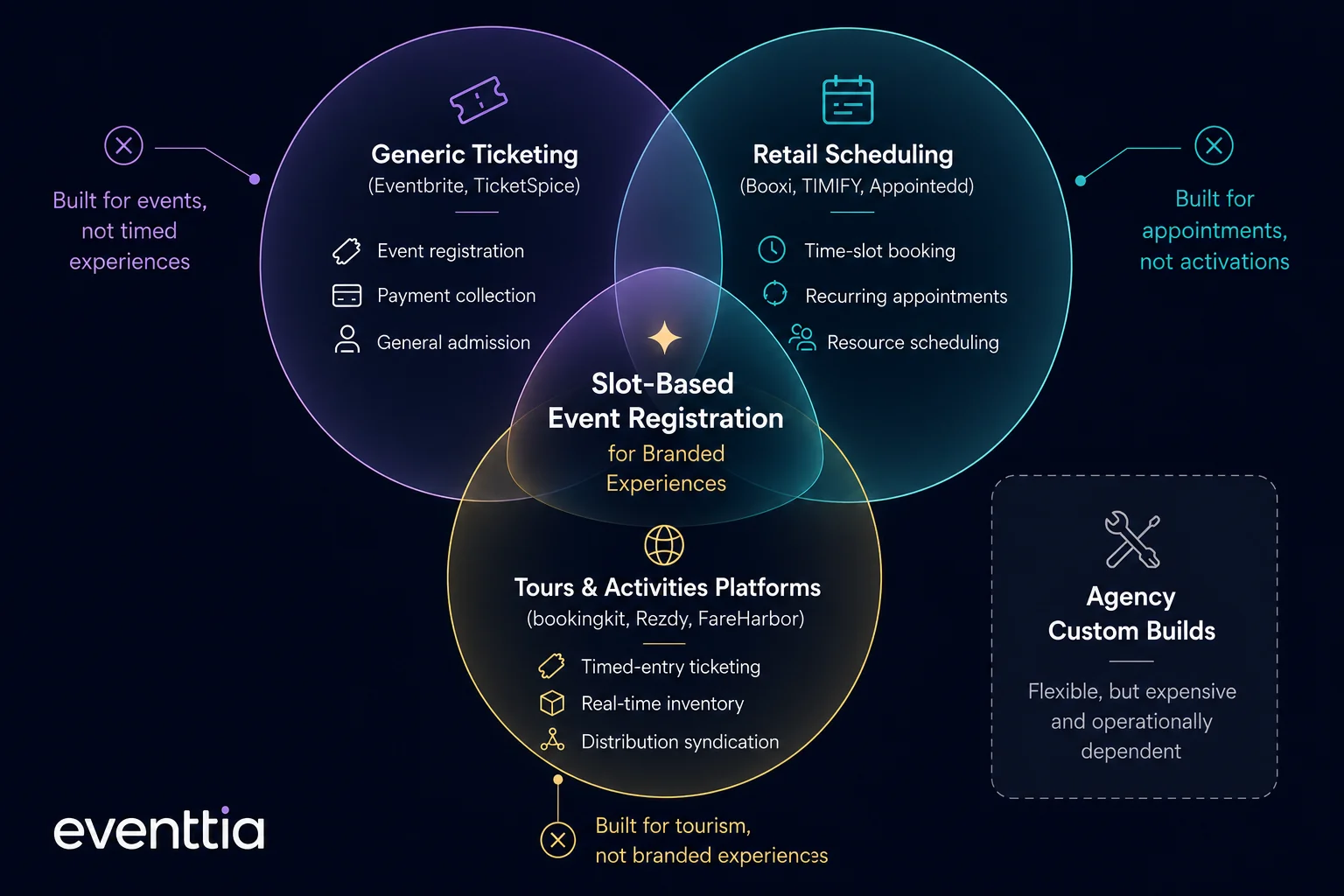
- Why does it need dedicated infrastructure? Generic ticketing platforms lack native slot management and modification flexibility. Retail appointment scheduling tools lack event registration workflows, group booking, and payment processing. Tours and activities platforms are built for B2C leisure distribution, not branded private activations. Brands either settle for tools that partially fit, or pay agencies to build custom solutions they cannot manage themselves.
- What does a purpose-built solution look like? A registration page with calendar-based slot selection, real-time capacity management, self-service modification and cancellation for attendees, group booking, confirmation emails with QR codes or Wallet Passes, automated reminders, multilingual support, integrated payment processing (Stripe, PayPal, Adyen), slot-based access control for check-in, and a back-office where the organizing team manages everything autonomously.
- Real-world context. This article draws on deployment patterns observed across brand activations in Europe and the Americas, including product exhibitions running hundreds of time slots across multiple weeks, children’s retail experiences with group booking, private sales operations, and luxury activations serving visitors in multiple languages.
What slot-based event registration actually is
Slot-based event registration (also known as timed-entry registration, timed-entry ticketing, time-slot booking, or session-based registration) is a system where attendees register for a specific date and time window within a defined capacity. Unlike standard event registration, where attendees sign up for an event as a whole, slot-based registration divides the experience into discrete time periods. Each period has its own capacity limit, and availability is managed in real time.
The concept is straightforward. A brand opens a product exhibition that runs for three weeks. Visitors can book 30-minute or 45-minute viewing sessions. Each session accommodates a limited number of guests. The registration page shows a calendar with available dates, the time slots within each date, and the remaining capacity for each slot. When an attendee completes a booking, capacity updates instantly for the next visitor. When an attendee cancels or modifies their booking, the freed capacity is automatically restored.
Appointment booking or slot-based registration?
Both terms describe the same core mechanic: an attendee selects a date, chooses a time window, and the system manages capacity in real time. In retail contexts, this is typically called appointment booking. In event contexts, it is called slot-based registration. Both are valid. Eventtia uses “Appointment Booking” as the configuration mode in its platform, and supports both vocabularies.
The meaningful distinction is not between “appointment” and “slot.” It is between time-based booking and program-based registration. Time-based booking is a single activity with multiple time windows: one exhibition, one private sale, one test drive program, divided into bookable slots. Program-based registration is a multi-activity event with an agenda, speakers, and session selection: a conference, a summit, a multi-day training. This article focuses on the time-based model.
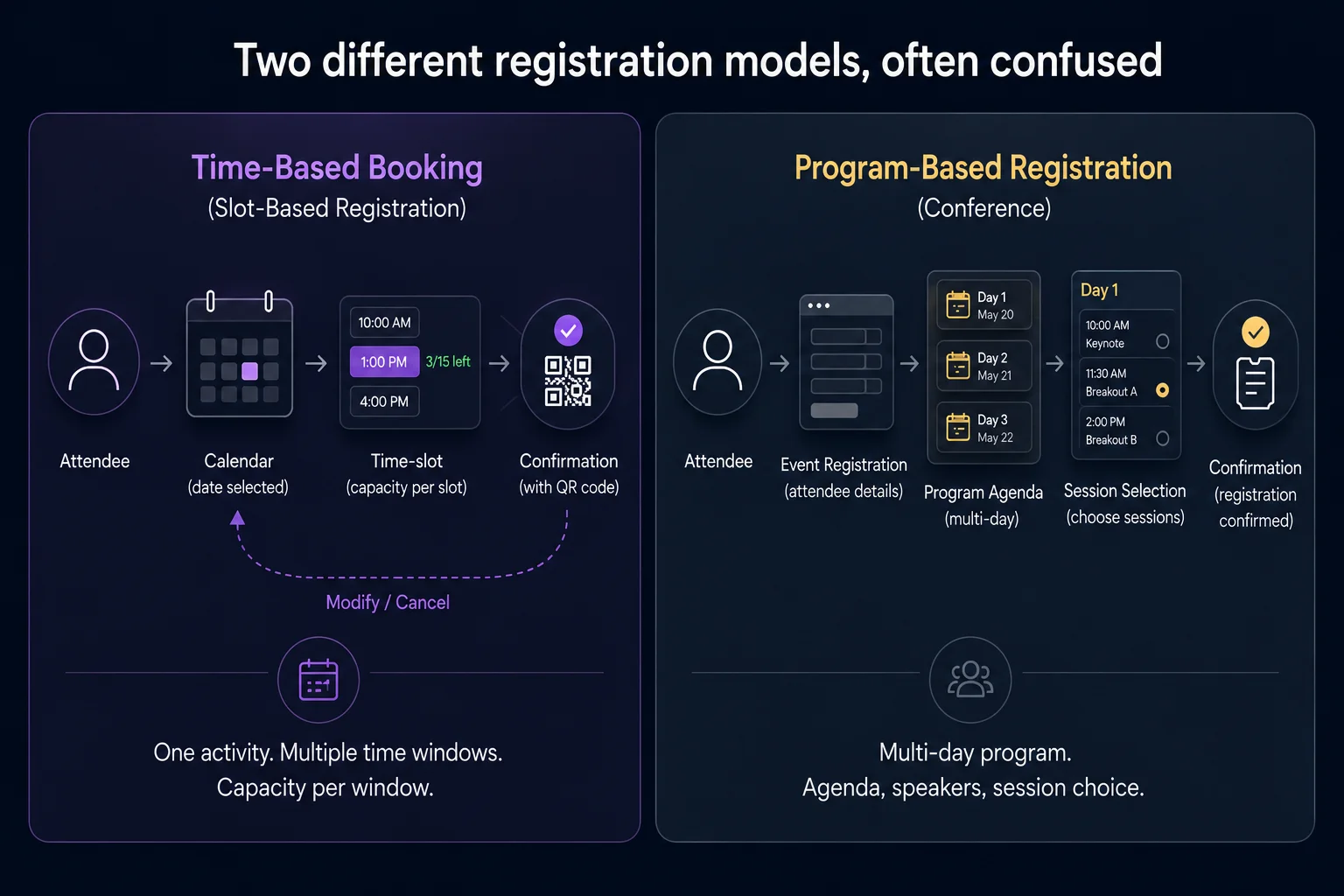
This matters because the tools designed for each model are architecturally different. Retail appointment platforms like Booxi, TIMIFY, and Appointedd are built for ongoing, recurring in-store services: personal shopping, styling consultations, store appointments. They excel at that. But when the use case shifts from an ongoing service to a time-limited branded experience — a three-week exhibition, a seasonal pop-up, a quarterly private sale — the requirements change. You need event registration capabilities: group booking with named and anonymous modes, integrated payment processing, event cloning for repeat activations, QR code check-in, automated reminders, and post-event communications. That is where appointment scheduling tools reach their architectural limits. Not because the time-slot logic is different, but because the surrounding event workflow is.
Why brands need slot-based registration
Organizations that run capacity-controlled physical experiences share a specific set of requirements that mainstream event tools do not address well.
The experience is capacity-controlled by design
These are not open-door events. A product viewing might accommodate 15 people per 30-minute slot. A private sale might cap at 50 visitors per hour. A test drive program might offer 8 appointments across a Saturday afternoon. Capacity management is not a nice-to-have feature. It is the operational core of the experience. The system must prevent overbooking, hide sold-out slots, and reflect real-time availability without manual intervention.
Attendees need to modify and cancel without friction
Schedules change. A guest who booked a Tuesday afternoon slot needs to move to Thursday. A family that registered for a weekend workshop has a conflict and needs to cancel. If the system requires the organizer to manually process every change, or forces the attendee through a cancel-and-rebook cycle, the operational burden scales with every booking. A purpose-built system lets attendees modify or cancel their own slots through links in their confirmation email, with capacity automatically rebalancing in real time. The organizer’s team can also make changes from the back-office when needed.
Events repeat and scale across locations
A single pop-up activation might run for two weeks with daily sessions. A test drive program might operate across three dealerships simultaneously. A private sale might repeat quarterly across multiple markets. A gallery exhibition might extend for months, adding new date ranges as demand grows. The team managing these activations cannot rebuild the registration infrastructure from scratch each time. They need to clone previous configurations, update the calendar, adjust capacity, and go live in a matter of hours.
The organizing team must be autonomous
This is the most important operational requirement. When a brand works with an agency to build a custom registration page, every change goes through the agency: updating a date, adjusting capacity, modifying an email template. The brand has no backend access. Every iteration costs time and money. A SaaS solution inverts this: the organizing team manages slots, capacity, content, and communications from a back-office dashboard.
{% include post-callout.html variant=”gradient” title=”The shift in one sentence” body=”Stop looking for a ticketing tool that supports time slots. Start looking for an event platform built around them.” %}
The alternatives brands currently use, and where they fall short
When organizations look for solutions to manage slot-based experiences, they consistently encounter the same categories of tools. None fully solves the problem.
Generic ticketing platforms
Platforms like Eventbrite are fast to configure. You can create an event, add time slots, set capacity, and publish within hours. A wave of timed-entry ticketing tools also emerged post-COVID (TicketSpice, SimpleTix, Ticket Fairy), designed specifically for capacity-controlled admission at museums, parks, and attractions. For small, low-stakes events where speed matters more than operational control, they work.
The limitations appear with scale and flexibility. These platforms treat time slots as variations of a general ticketing event, not as a native architectural concept. Creating a single central activity with dozens or hundreds of time slots, each with its own capacity, and giving attendees clear real-time visibility into availability when booking, is either cumbersome or impossible. When an attendee needs to reschedule, the workflow typically requires a full cancel-and-rebook cycle rather than a seamless slot change. And for brands that need their visual identity preserved, the experience carries the platform’s branding throughout.
Retail appointment scheduling platforms
Tools like Booxi, TIMIFY, Appointedd, and Calendly handle time slots natively and are well-designed for one-on-one or small-group interactions. Some are specifically built for retail environments: Booxi works with luxury maisons for personal shopping and clienteling, TIMIFY serves enterprise multi-location scheduling for brands like BMW and Ikea, and Appointedd focuses on beauty and retail brands such as Charlotte Tilbury and Space NK.
The core time-slot mechanic is the same as slot-based registration. The limitation is the surrounding workflow. These are scheduling tools, not event registration tools. They lack the event-specific capabilities that slot-based activations require: multiple attendee types within a single booking, integrated payment processing for ticketed events, group registration (both named and anonymous), configurable ticket limits per person, event cloning for repeat activations, automated reminder sequences, and post-event email communications. When a private sale or a paid exhibition requires payment collection at the point of registration, scheduling tools either cannot support it or offer it as a limited bolt-on.
Tours and activities platforms
Tools like bookingkit, Rezdy, FareHarbor, and Peek are designed for experience providers selling timed-entry tickets through online travel agencies and distribution channels. They handle slot-based booking natively, with real-time capacity management and QR code ticketing.
The limitation is the target market. These platforms are built for B2C tourism and leisure: museums, escape rooms, city tours, theme parks. They are optimized for distribution channel syndication (connecting to GetYourGuide, Viator, TripAdvisor), not for branded private activations. When a brand needs to modify bookings flexibly, the workflow often requires cancelling the original order and having the attendee rebook from scratch. For organizations running private sales, corporate activations, or branded experiences, the operational model does not fit.
Agency-built custom solutions
The alternative is to hire a digital agency to build a bespoke registration page. The result can be fully customized to the specific event.
The cost is the first problem. Custom builds for slot-based registration with booking logic, real-time availability, and email automation can run into tens of thousands of euros per event. The dependency is the second, larger problem. The brand has no back-office. Updating a date, adding a time slot, modifying an email, adjusting capacity: all of this goes through the agency. And the technical debt is the third. Agency-built solutions are one-off projects, not platforms. There is no slot management dashboard, no real-time availability engine, no reusable infrastructure.
What a purpose-built slot-based registration system looks like
A slot-based registration system designed for branded experiences combines several capabilities that typically live in separate tools.
- Calendar-based slot selection. The attendee sees a calendar showing available dates. Selecting a date reveals the time slots for that day, with the number of remaining spots visible for each slot. The interface is visual, intuitive, and designed for consumer-facing use, not for booking a meeting with a service provider.
- Real-time capacity management. When a booking is confirmed, the available capacity for that slot decreases instantly. When an attendee cancels or modifies their booking, the freed capacity is automatically restored and the slot becomes available again. There is no lag between the booking action and the availability update.
- Self-service modification and cancellation. Attendees receive modification and cancellation links in their confirmation email. They can reschedule to a different available slot or cancel their booking entirely, without contacting the organizer. The system handles capacity rebalancing automatically. This eliminates the manual processing burden that plagues ticketing and scheduling platforms where every change requires organizer intervention.
- Group booking with named and anonymous modes. Many experiences involve group registrations, and not all groups work the same way. In named registration, each person is individually identified and receives a personal QR code. In anonymous registration, the main participant registers a number of guests without capturing each person’s identity. All QR codes are sent to the main registrant. Anonymous mode is common for children’s events and family activities, where capturing every attendee’s details is unnecessary.
- Configurable ticket limits per person. The organizer can set a maximum number of tickets per registration. This limit can be configured differently for each event, allowing tight control for intimate VIP viewings (one ticket per person) and more flexibility for family-oriented activations (multiple tickets per booking).
- Payment integration. Some slot-based events are free: VIP previews, product launches by invitation, corporate activations. Others are paid: gallery exhibitions, masterclass programs, private sales, retail workshops. The system integrates with payment processors including Stripe, PayPal, and Adyen to handle ticket pricing, group totals, and payment confirmation within the registration flow.
- Multilingual support. Brands operate internationally. A gallery in Paris needs French, English, and Italian on the same registration page. An automotive brand running test drives across Asia needs Chinese, Japanese, and Korean. Eventtia supports up to 15 major languages, including Chinese, Japanese, Korean, and Arabic, within a single registration page with language switching available to the attendee.
- QR codes and mobile wallet integration. Each attendee receives a unique QR code upon registration. For group bookings, individual QR codes are generated for each participant and consolidated in the main registrant’s confirmation email. Dynamic Wallet Passes (Apple Wallet, Google Wallet) display the booked slot details and update automatically if the booking is modified.
- Automated reminders and post-event emails. The system sends automated reminder emails before the booked slot, reducing no-shows. After the event, post-event email communications can be triggered automatically, enabling follow-up surveys, thank-you messages, or invitations to future activations.
- Slot-based access control and check-in. A check-in application validates attendees against their booked slot via QR code scan. In practice, access control needs to be flexible: guests may arrive early or late, and organizers often prefer to accommodate them rather than turn them away. The check-in app supports this flexibility, allowing organizers to check in attendees who arrive outside their exact slot window while still tracking capacity per session.
- Optional white-label front-end. For organizations that need complete branding control over the registration experience, white-label is available: custom domain or subdomain, brand typography, color palette, logo, banner, and footer, with no third-party platform branding visible to the attendee. This is particularly relevant for luxury houses and premium brands where the registration page is an extension of the brand experience.
- Back-office slot management. The organizing team manages all operational aspects from a dashboard: creating new time slots, adjusting capacity, hiding or revealing slots, uploading slot configurations via spreadsheet, cloning events for repeat activations, and monitoring registrations in real time.
Autonomy from the first event is the goal. Independence from the second event is the expectation.
Deployment patterns observed in practice
Several patterns have emerged from slot-based registration deployments across industries.
Private sales and exclusive retail events
A brand runs a private sale or an exclusive shopping event for loyalty members or VIP clients. Attendees book timed entry slots to control foot traffic and ensure a premium experience. Modification and cancellation flexibility is critical because VIP guests expect to reschedule without friction. The event may repeat quarterly or seasonally, with the infrastructure cloned and adapted each time.
Exhibitions and product viewings
A watchmaker, jeweler, or art gallery opens a seasonal exhibition. The exhibition runs for several weeks with daily viewing sessions of 30 to 45 minutes. Capacity per session is limited. Registration is free but required. Multilingual support is essential as the exhibition draws international visitors.
{% include post-callout.html title=”In practice: Van Cleef & Arpels at Raffles Hotel Singapore” body=”Since 2024, Van Cleef & Arpels has operated ‘Les Jardins Secrets,’ a permanent exhibition space within Raffles Hotel Singapore. The space hosts rotating exhibitions, each running approximately three to six months, with daily timed-entry sessions from 12pm to 8pm. Visitors register for free through Eventtia’s slot-based registration system, selecting their preferred date and time. The platform manages real-time capacity across hundreds of slots per exhibition cycle, with multilingual registration for Singapore’s international visitor base. Four exhibitions have been hosted since launch — a continuous slot-based registration operation running for over two years.” %}
Seasonal brand activations
A brand creates a seasonal pop-up experience, often around holidays or collection launches. Families book timed visits that may include children’s activities, product previews, or interactive experiences. Anonymous group booking is central: one parent registers the family, each member receives a QR code, but only the main registrant’s details are captured. The activation runs for a defined period, then the infrastructure is cloned for the next one. Repeat activations can go live in a matter of hours.
{% include post-callout.html title=”In practice: Ralph Lauren seasonal activations” body=”Ralph Lauren uses Eventtia’s slot-based registration to manage recurring seasonal brand activations. Each activation runs for a limited period with timed visitor sessions. The registration page is fully branded and supports group booking for families. After the first deployment, the team clones the previous event configuration and launches new activations independently, reducing setup time from weeks to hours. Recent activations include immersive experiences like ‘The Ralph Lauren Palazzo,’ where visitors book timed slots to explore a branded environment.” %}
Automotive test drives and experience days
An automotive brand offers test drive appointments at dealerships or at a dedicated experience center. Each time slot accommodates a limited number of drivers. Registration captures attendee details, driving license confirmation, and vehicle preference. The program may run across multiple locations simultaneously.
Gallery and cultural institution ticketing
A gallery or cultural venue manages ongoing ticketing for exhibitions. Volume is higher than brand activations. The registration page handles multiple languages and integrates payment processing (Stripe, PayPal, or Adyen). The key operational need is sustained, long-running slot management, where dates and availability are updated weekly or monthly as the exhibition continues.
How slot-based registration differs from adjacent solutions
| Capability | Slot-based registration (Eventtia) | Generic ticketing (Eventbrite, TicketSpice) | Retail scheduling (Booxi, TIMIFY, Appointedd) | Tours & activities (bookingkit, Rezdy) |
|---|---|---|---|---|
| Time-slot selection with per-slot capacity | Core feature | Available but limited | Core feature | Core feature |
| Group booking (named and anonymous) | Yes, both modes | Limited | Limited | Limited |
| Self-service modification & cancellation | Yes, auto capacity rebalancing | Cumbersome | Varies | Cancel-and-rebook |
| Configurable ticket limit per person | Yes, per event | Limited | Varies | Varies |
| Payment integration (Stripe, PayPal, Adyen) | Yes | Yes (platform-managed) | Partial | Yes |
| Multilingual (15+ languages) | Yes | Limited | Limited | Yes |
| Event cloning for repeat activations | Yes | Limited | No | Limited |
| QR codes + Mobile Wallet Pass | Yes | QR only | Varies | QR only |
| Slot-based access control (flexible enforcement) | Yes | Basic | Varies | Basic |
| Automated reminders & post-event emails | Yes | Yes | Varies | Limited |
| White-label branding (optional) | Available as add-on | No | Partial (widget) | Limited |
| Back-office slot management | Yes, autonomous | Yes, basic | Yes | Yes |
{% include post-callout.html variant=”mono” title=”Rule of thumb” body=”If your tool was built for ongoing retail services, you’ll hit the event workflow ceiling. If it was built for B2C distribution, you’ll hit the branding ceiling. If it was built for general ticketing, you’ll hit the modification ceiling. Slot-based registration is the category that sits where all three ceilings overlap.” %}
Frequently asked questions
What is slot-based event registration?
Slot-based event registration (also called appointment booking in retail contexts) is a system where attendees book a specific date and time window for a capacity-controlled experience. Each time slot has a defined number of available spots, and availability updates in real time as bookings are made. Eventtia provides slot-based registration as a standardized service for brands, retailers, galleries, automotive companies, and cultural institutions.
How is slot-based registration different from appointment scheduling?
The core time-slot mechanic is the same: an attendee selects a date and time, and capacity is managed. The difference is the surrounding workflow. Appointment scheduling tools like Booxi, TIMIFY, and Calendly are designed for ongoing retail services: personal shopping, consultations, fittings. Slot-based registration is designed for time-limited event experiences: exhibitions, product launches, private sales, test drives. It includes event management capabilities such as group booking, integrated payment processing, event cloning, automated reminders, post-event emails, slot-based check-in, and configurable ticket limits per person.
Can attendees modify or cancel their own bookings?
Yes. Attendees receive modification and cancellation links in their confirmation email. They can reschedule to a different available slot or cancel entirely without contacting the organizer. When a booking is modified or cancelled, the system automatically rebalances capacity, making the freed slot available for other attendees in real time. Organizers can also process changes from the back-office dashboard.
How does group booking work with slot-based registration?
Eventtia supports two group booking modes. In named registration, each group member is individually identified with their own details and receives a personal QR code. In anonymous registration, the main participant registers a number of guests without capturing each person’s identity. All QR codes are sent to the main registrant. Anonymous mode is common for children’s events and family activities. Organizers can also set a maximum number of tickets per person to control distribution.
How quickly can a slot-based registration page go live?
For a first deployment, Eventtia’s standardized setup process typically takes five working days, including configuration, email customization, and quality assurance. For repeat events, the organizing team can clone the previous configuration and go live in a matter of hours.
Does slot-based registration support multiple languages?
Yes. Eventtia supports up to 15 major languages, including French, English, Spanish, Italian, German, Portuguese, Chinese, Japanese, Korean, and Arabic. Attendees can switch between languages on a single registration page. All content, including event descriptions and transactional emails, can be localized per language.
Can attendees pay for their booking during registration?
Yes. Slot-based registration integrates with payment processors including Stripe, PayPal, and Adyen. This supports paid experiences like gallery exhibitions, workshops, private sales, and masterclass programs. Free registration for invitation-only events is equally supported.
How does check-in work for slot-based events?
Eventtia provides a check-in application that validates attendees via QR code scan against their booked slot. The app is designed for operational flexibility: organizers can check in attendees who arrive early or late, rather than rigidly enforcing slot boundaries. This is particularly important for VIP activations where turning away a guest due to a minor schedule shift is not acceptable. The system tracks actual attendance per slot in real time.
What is the difference between using a SaaS platform and an agency for slot-based registration?
An agency builds a custom registration page per event. The result can be fully customized, but the organization has no back-office access. Every change, from updating a date to modifying an email, requires agency involvement. A SaaS platform like Eventtia provides self-service management from the start. The organizing team manages slots, capacity, content, and communications autonomously after initial setup.
Can I use slot-based registration for recurring events across multiple locations?
Yes. Eventtia supports event cloning, which allows organizations to duplicate the entire registration configuration, including page design, slot structure, email templates, and form fields. For brands running seasonal activations, rotating exhibitions, test drive programs, or multi-location private sales, each new event builds on the previous one rather than starting from scratch.
Eventtia is the platform behind the brands setting the standard.
Talk to us about how the platform fits into your stack — registration, communications, on-site, and analytics, exposed deeply enough to compose.

Keep reading.
The Psychology of Uncertainty, or How to Connect People at Events
Events are a way to bring people together and provide a common space for interaction and sharing. People attend events to discover like-minded…

Top 8 Hospitality Platforms for Events and Consumer Experiences
This article provides an analysis of 8 top hospitality platforms for events, helping you to identify the one that works best for your requirements.
How to Use Data and Analytics to Plan a More Impactful Event
The recent surge of data available at our fingertips has brought new opportunities for businesses and event marketers.